
Do you know what to do when the alarm siren goes off at work? Where to evacuate and which route to take when the corridor is filling with smoke? During the fire safety course you will practise an evacuation, learn the alarm signals and find out how to use extinguishing equipment safely. When there is a fire, there is no time to look for instructions – the practical nature of the course builds Participants' readiness to act in the face of danger.
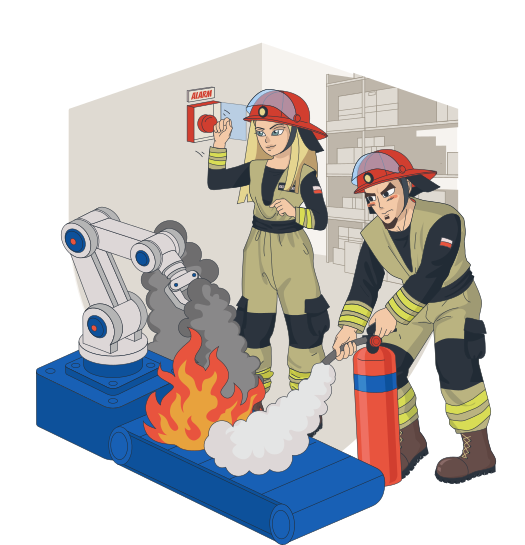
Fire Safety
Fire protection rules – a course full of practice
| Training programme | Topic | What will you learn? | Format | Time |
| Legal regulations and employer obligations | 1. You will learn the basic fire protection regulations that apply in workplaces. 2. You will learn the obligations of both the employer – in ensuring fire protection at work – and the employee. | Lecture | 15 min | |
| 1. You will practise identifying the regulations that apply in your workplace. 2. You will learn how to check whether a building meets fire safety requirements. 3. You will master the rules for designating fire zones and escape routes. | Practical workshops | 20 min | ||
| Fire hazards – causes and mechanisms | 1. We will discuss the most common causes of fires in office and industrial buildings. 2. You will learn how fire and smoke spread in a building and what affects the speed of a fire. 3. You will learn which prohibited activities drastically increase the risk of fire. | Lecture | 15 min | |
| 1. You will analyse real fire scenarios and identify their original causes. 2. You will learn to recognise places and situations particularly at risk of fire in your workplace. 3. You will practise eliminating typical fire hazards in your daily work. | Practical workshops | 20 min | ||
| Raising the alarm and notifying the emergency services | 1. You will learn the rules for correctly alerting building users and notifying the State Fire Service. 2. You will learn how to report a fire effectively and which tools / apps can help you. 3. You will memorise the emergency numbers and the rules for cooperating with the emergency services during an operation. | Lecture | 10 min | |
| 1. You will practise the fire reporting procedure in simulated conditions – from spotting the fire to contacting the fire service. 2. You will master the internal alarm system and manual call points. 3. You will learn to direct other people in the building efficiently in the first moments after the danger is detected. | Practical workshops | 20 min | ||
| Evacuation of people and property | 1. We will discuss the rules for organising a safe evacuation of employees and property from the building. 2. You will learn the roles and duties of the people appointed to lead the evacuation and the list of people appointed to give pre-medical first aid. 3. You will learn the rules for designating and marking assembly points and how to act in special situations, such as heavy smoke or blocked escape routes. | Lecture | 10 min | |
| 1. You will walk around the building and identify escape routes, emergency exits and the location of evacuation plans and the Fire Safety Instructions. 2. You will practise carrying out a smooth evacuation of a group of employees in line with the applicable procedure. 3. You will learn how to act in difficult situations – a blocked escape route, helping people with reduced mobility. | Practical workshops | 20 min | ||
| Portable firefighting equipment – design and use | 1. You will learn the types of fire extinguishers (powder, CO2, water), how they are built, what they are for and how to choose them for the type of fire. 2. You will learn how to use a fire extinguisher and a fire blanket correctly to put out a fire effectively in its early stage. 3. You will understand where firefighting equipment should be placed in a building and how to check that it works. | Lecture | 10 min | |
| 1. You will practise putting out a simulated fire using different types of extinguishing agents. 2. You will master the use of a fire blanket in simulated conditions. 3. You will see how dangerous incorrect firefighting can be and why choosing the right extinguishing agent for the type of fire is crucial | Practical workshops | 30 min | ||
| Fire protection systems and equipment in the building | 1. You will learn about the types of fire protection systems used in buildings – smoke detection systems, sprinklers, smoke extraction systems and internal hydrants. 2. You will learn where the main switches and valves of the technical installations in your building are located. 3. You will understand how the individual parts of the system work and what your role is when they are activated. | Lecture | 10 min | |
| 1. You will walk through your building and identify the actual location of firefighting equipment, hydrants, main switches, escape routes and basic fire safety signs – so that after the course you can move around it confidently, even in an emergency 2. You will learn the practical use of portable firefighting equipment and the internal hydrant system. | Practical workshops | 20 min | ||
| Smoke chamber – hazard simulation | 1. You will learn how to behave in a heavily smoke-filled environment – where to look for air, how to move and how to locate casualties. 2. You will learn the principles of giving pre-medical first aid to a casualty after evacuation from the danger zone. 3. You will understand why smoke is more dangerous than fire and how to limit its effect on the body during evacuation. | Lecture | 10 min | |
| 1. You will take part in a smoke chamber exercise – you will try to find a casualty in a smoke-filled corridor and evacuate from the room. 2. You will practise putting out a fire after leaving the chamber and giving Pre-medical First Aid to an evacuated casualty. 3. You will master finding your way in a smoke-filled room using evacuation signs. | Practical workshops | 30 min | ||
| Customisation | This offer describes a standard course covering the basics everyone should know. If you have other needs, want the course to cover specific situations and ways of responding that interest you – let us know, we will adapt the offer especially for you and create a training tailored to your needs! | |||
| Introduction | Did you know that most fires at work can be put out in their early stage – but only if employees know what to do? We will teach you to act quickly and effectively in an emergency – without panic, without mistakes. Forget dry regulations – join a dynamic, practical fire protection course! |
| Duration | 4 training hours full of practical workshops |
| Course format | In-person training at a location chosen by the Client. If you do not have your own training space, we can also organise the course at the Ratowacze training centre. |
| Group size | Small training groups – up to 20 people, to keep the workshops practical |
| Goal | During the course you will discover your readiness to act in the face of danger, gain practical skills in putting out fires and evacuating efficiently, and the confidence that in a crisis you know exactly what to do. |
| Course fee for individuals: PLN 150 |
| We always try to adapt the course to your individual needs. If you are looking for a course for your Company/Organisation we will prepare a dedicated offer for you. W takim przypadku wypełnij formularz kontaktowy znajdujący się pod opisem usługi – na podstawie Twoich odpowiedzi przygotujemy ofertę dopasowaną do Twoich potrzeb. |
| For course Participants | Above all, REAL SKILLS – after the course you will know how to put out a fire, evacuate your colleagues efficiently and stay calm where others panic |
| Personal certificate of completion – confirming the fire protection skills you have gained. | |
| Why choose our course? | Minimum boredom, maximum practice: We focus on exercises, simulations and real-life scenarios – including putting out real fire with different types of extinguishers and firefighting equipment. |
| Experienced instructors: Certified fire protection specialists who combine solid knowledge with the ability to engage Participants. | |
| Friendly atmosphere: We teach without stress, building your self-confidence – because in a crisis, calm and automatic action are what count. |

Fire safety training for employees – practice instead of slides
Most fires at work can be brought under control in their early stage – provided employees know what to do. Our fire safety training for employees lasts 4 training hours and is based on practical workshops: we practise raising the alarm, evacuation and putting out a simulated fire. We train in small groups – up to 20 people – at our centres in Kraków, Niepołomice and Kielce or at the Client's premises all over Poland. We are constantly expanding our training base – more permanent locations are planned.
Each topic in the programme combines a short lecture with an exercise: regulations and the obligations of employers and employees, the causes and mechanisms of fires, raising the alarm and notifying the services, evacuation of people and property, portable firefighting equipment and fire protection systems in the building.
Fire extinguisher and fire blanket training
During the course you will learn the types of fire extinguishers – powder, CO2 and water – how they are built, what they are for and how to choose them for the type of fire. You will then practise putting out a simulated fire with different extinguishing agents and using a fire blanket. You will also see how dangerous incorrect firefighting can be and why choosing the right extinguishing agent is crucial.
Employee evacuation training
We practise evacuation in your building: we walk the escape routes and emergency exits, check the location of evacuation plans and the Fire Safety Instructions, and then evacuate a group of employees in line with the applicable procedure. We discuss the roles of the people leading the evacuation and difficult situations – a blocked escape route, heavy smoke or helping people with reduced mobility.
Employees also learn to recognise alarm signals, use manual call points and direct other people in the first moments after the danger is detected.
Fire safety training in Kraków and all over Poland
We run fire safety training in person – some exercises, e.g. firefighting and walking through the building, require on-site work. We adapt the programme to the specifics of the workplace: an office, public office, production hall, warehouse, school or hotel. Fire safety training goes well together with health & safety training and a first aid course, and you will find ongoing support with fire protection – documentation, fire hazard assessment and evacuation drills – in our offer of fire safety outsourcing.
Ask about training
Frequently asked questions (FAQ)
How long is fire safety training?
4 training hours, mostly practical workshops.
Does fire safety training include putting out a fire?
Yes – Participants practise putting out a simulated fire with different extinguishing agents and using a fire blanket.
Can we practise an evacuation in our building?
Yes – during training at your premises we walk the escape routes and evacuate a group of employees in line with the procedure.
How many people can take part in the training?
We train in small groups – up to 20 people.
Do you run fire safety training online?
No – we run fire safety training in person, because the key exercises require on-site work.