First aid for children and infants – for parents and carers
Choking on a piece of food, a high fever with seizures, sudden loss of consciousness – at moments like these, a parent is the first one with the child. Our first aid course for children and infants teaches you how to recognise danger and what to do step by step before help arrives.
The course lasts 4 training hours and largely consists of exercises on realistic child and infant manikins. We train in small groups – up to 20 people (with more than 12 Participants the course is always run by at least two Instructors) – parents, grandparents, nannies and all carers of young children.
First Aid for Children and Infants
First aid for parents and carers. Learn what to do when a child's or an infant's life is in danger
| Training programme | Topic | What will you learn? | Format | Time |
| BLS – Basic Life Support | 1. You will learn the absolute basics – the gold standard of saving lives. It is your first and most important step in learning how to respond when every second counts. 2. We explain in simple words the mechanisms that lead to sudden cardiac arrest in the youngest casualties, and teach you to recognise and respond to this danger. 3. We will also cover the practical legal aspects of first aid. | Lecture | 30 min | |
| Chain of survival | 1. You will understand why an immediate reaction from bystanders is crucial for the casualty. 2. We explain how much your actions at the scene matter, what steps to take to make the rescue more effective and how important a fast reaction is. You will learn about useful apps for calling the emergency services and supporting you while giving first aid. | Lecture | 30 min | |
| Effective resuscitation of children and infants | 1. We will teach you how to perform cardiopulmonary resuscitation (CPR) correctly on children and infants, using modern, realistic manikins | Practical workshops | 60 min | |
| Defibrillation in cardiac arrest in children and infants | 1. We will show you how to use an Automated External Defibrillator (AED) correctly – a device that increases the chance of survival in cardiac arrest 2. You will also find out where AEDs can be found in public spaces | Practical workshops | 60 min | |
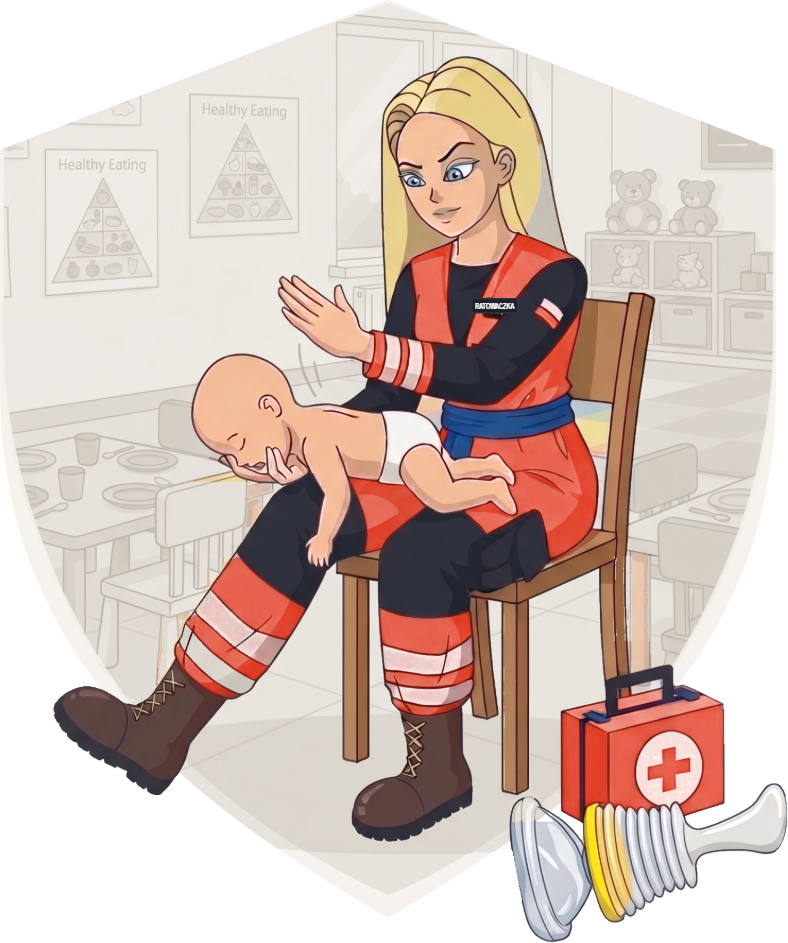
| Choking in children and infants | 1. We will teach you safe techniques for clearing the airway in the event of choking, which is the most common cause of breathing arrest in children and infants. 2. We will present devices that help you respond effectively to choking. | Practical workshops | 60 min | |
| Responding to medical emergencies | 1. You will learn to recognise the symptoms and respond correctly to emergencies typical for children – such as seizures, fever, allergic reactions or fainting. 2. We will bust the most common myths about how to act in these situations. | Practical workshops | 60 min | |
| Injuries in children and infants | 1. We will teach you how to treat the most common injuries in children, minimising pain and the risk of complications. 2. You will learn about dressings designed for specific injuries, as well as how to cope when you do not have specialist equipment at hand. | Practical workshops | 60 min | |
| Customisation | This offer describes a standard course covering the basics everyone should know. If you have other needs, want the course to cover specific situations and ways of responding that interest you – let us know, we will adapt the offer especially for you and create a training tailored to your needs! | |||
| Introduction | Did you know that in a life-threatening situation it is the first few minutes and your reaction that can be crucial? In medical emergencies, quickly recognising the symptoms, assessing the situation correctly and acting immediately can genuinely save someone's life and affect the casualty's future health. On our course you will learn to act quickly, consciously and effectively. We will show you how to recognise the first symptoms of medical emergencies and what to do for the casualty before the emergency services arrive. You will learn what is worth having in your first aid kit, which medicines can be given in specific situations and which rescue tools you can have yourself, so that you feel more confident wherever you are. We will teach you how to stay calm under stress and why composure and confident action matter so much in life-threatening situations. We focus on learning to recognise symptoms through realistic scenarios. We want to prepare you not only to help others, but also to look after your own safety and health. |
| Duration | 4 training hours |
| Course format | In-person training at a location chosen by the Client. If you do not have your own training room, we can also organise the course at the Ratowacze training centre |
| Group size | Small training groups – up to 20 people, to keep the workshops practical |
| Goal | During the course you will discover the strength to help others, gain practical skills in first aid for medical emergencies and the Power to save lives, which will stay with you forever |
| Course fee for individuals: PLN 200 |
| We always try to adapt the course to your individual needs. If you are looking for a course for your Company/Organisation we will prepare a dedicated offer for you. In that case, fill in the contact form below the service description – based on your answers we will prepare an offer tailored to your needs. |
| For course Participants | Above all, REAL SKILLS – after the course you will feel ready to act in an emergency. |
| Personal certificate of completion – confirming the skills you have gained. | |
| Why choose our course? | Minimum boredom, maximum practice: We focus on exercises, simulations and real-life scenarios. |
| Experienced instructors: Passionate people with a lifesaver's heart who can pass on knowledge in an accessible way. | |
| Friendly atmosphere: We teach without stress, building your self-confidence. |
First aid course for children and infants – what will you learn?
During the first aid course for children and infants we go through the situations that worry parents most:
- Recognising sudden cardiac and respiratory arrest in a child and an infant.
- Cardiopulmonary resuscitation of children and infants – with the youngest we start with 5 rescue breaths.
- Using an AED on a child – including the paediatric mode or electrodes.
- Choking – back blows between the shoulder blades and chest thrusts for an infant; back blows and abdominal thrusts for an older child.
- The recovery position, calling for help and apps that help with it.
- Responding to selected medical emergencies.
You will find the full programme above, in the “First Aid for Children and Infants” tab.
Why is first aid for a child different?
In children, cardiac arrest most often has a respiratory cause – e.g. choking or near-drowning – which is why resuscitation starts with rescue breaths and only then chest compressions. The compression technique is also different: in an infant the chest is compressed with two fingers or two thumbs, and in an older child – with one or two hands. These differences are best learned in practice, on a manikin, not from a video or a book.
A course for a group of parents
We will run the course for parents at a place of your choice – e.g. at a nursery for nursery parents, at an antenatal class or for a group of friends. We can also organise it at the Ratowacze training centre in Kraków, Niepołomice or Kielce. We are constantly expanding our training base – more permanent locations are planned. We train at Clients' premises all over Poland. If you want to sign up individually, ask us about the next date.
When a child's life is in danger, a bystander taking action – most often a parent – can decide whether they survive. It's worth having proven equipment in your home first aid kit – see home first aid kits. Read more in the article Choking.
Ask about training
Frequently asked questions (FAQ)
Who is the first aid course for children and infants for?
For parents, parents-to-be, grandparents, nannies and all carers of young children. No prior knowledge is needed.
How long is the course?
4 training hours, largely practical exercises on child and infant manikins.
How is CPR on a child different from CPR on an adult?
In children you start with 5 rescue breaths, and the compression technique is different – in infants with two fingers or thumbs. We practise the details on the course.
What should I do if an infant is choking?
Lay the infant face down along your forearm and give up to 5 back blows between the shoulder blades; if that doesn't help – up to 5 chest thrusts, alternating. If the infant loses consciousness, call for help and start CPR.
Can I sign up on my own?
Yes – ask us about the next date, or put together a group and we will organise the course at a place of your choice.